Question pages
Each question has its own page: a short answer, the evidence in the documents' own words, every passage quoted in full, and a link to each source.
Every question in a question web opens a page of its own. It answers the question in one or two sentences, shows the evidence in the documents' own words, and lists every passage it quotes, in full, with a link to open it at the source.
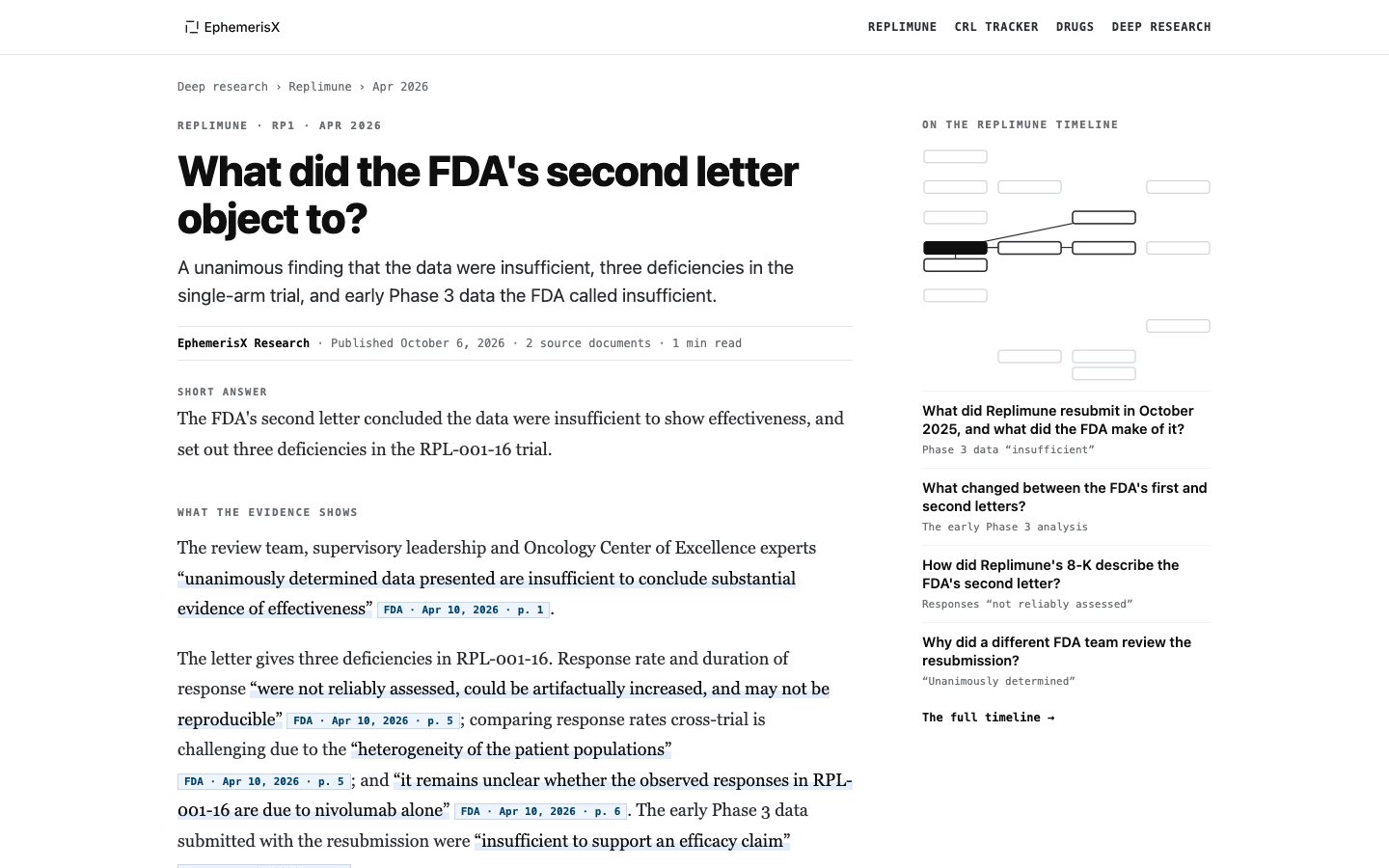
Parts of the page#
 1
2
3
4
5
6
7
8
1
2
3
4
5
6
7
8
- 1Breadcrumb. Deep research › Replimune › Apr 2026: the company's web and the question's period.
- 2The question. Above it, the company, product and period.
- 3Summary. What the answer found, in one line.
- 4Byline. The publication date, the number of source documents and the reading time.
- 5Short answer. The answer in one or two sentences, in our words.
- 6Citation chip. After every quotation: the source (FDA, 8-K, 10-K), its date and, for an FDA letter, the page. Click it to open the source at that page or passage; the same passage is shown in full further down the page.
- 7Position on the timeline. A small map of the company's timeline. The question is the black box; the questions it shares evidence with are outlined.
- 8Connected questions. The same questions, by name, each with what they share. The full timeline → returns to the web.
What the evidence shows#
Under What the evidence shows, the answer is told in full. Text inside quotation marks, underlined in blue, is the source's own words; everything else is ours, written to connect the quotes. Read it as a chain: each claim is followed by the passage that supports it and a chip saying where it is.
When an answer says a document does not mention something, that statement comes from a search of the whole document, not from a reading of part of it. See “Not in” statements.
Follow the thread, and the documents by date#
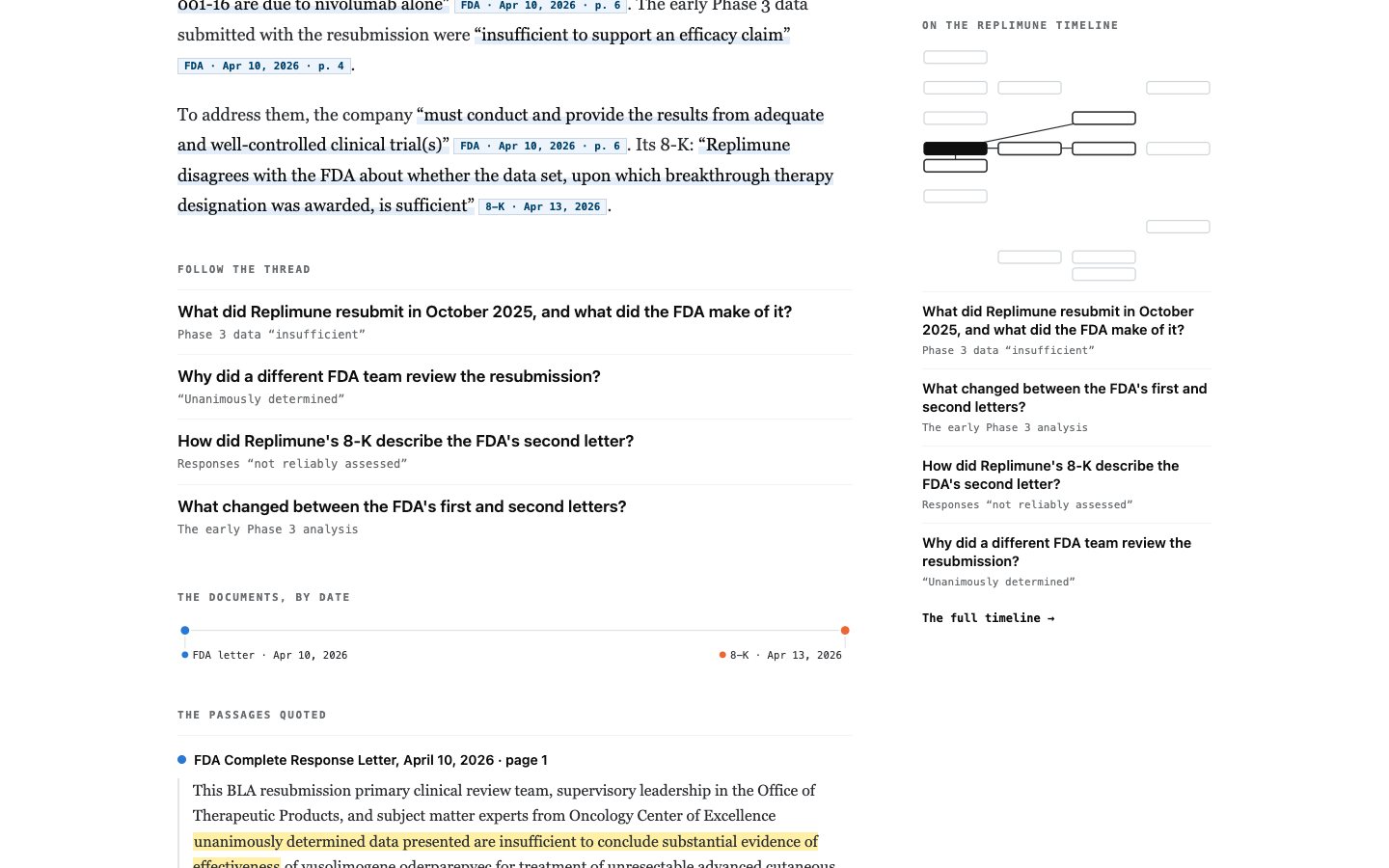
- Follow the thread lists the questions this one is connected to, with the shared passage in a few words, such as Phase 3 data “insufficient”. It is the same list as on the web, at reading length.
- The documents, by date puts every document the answer quotes on one line, blue for the FDA and orange for the company. Here, the 8-K came three days after the letter.
The passages quoted#
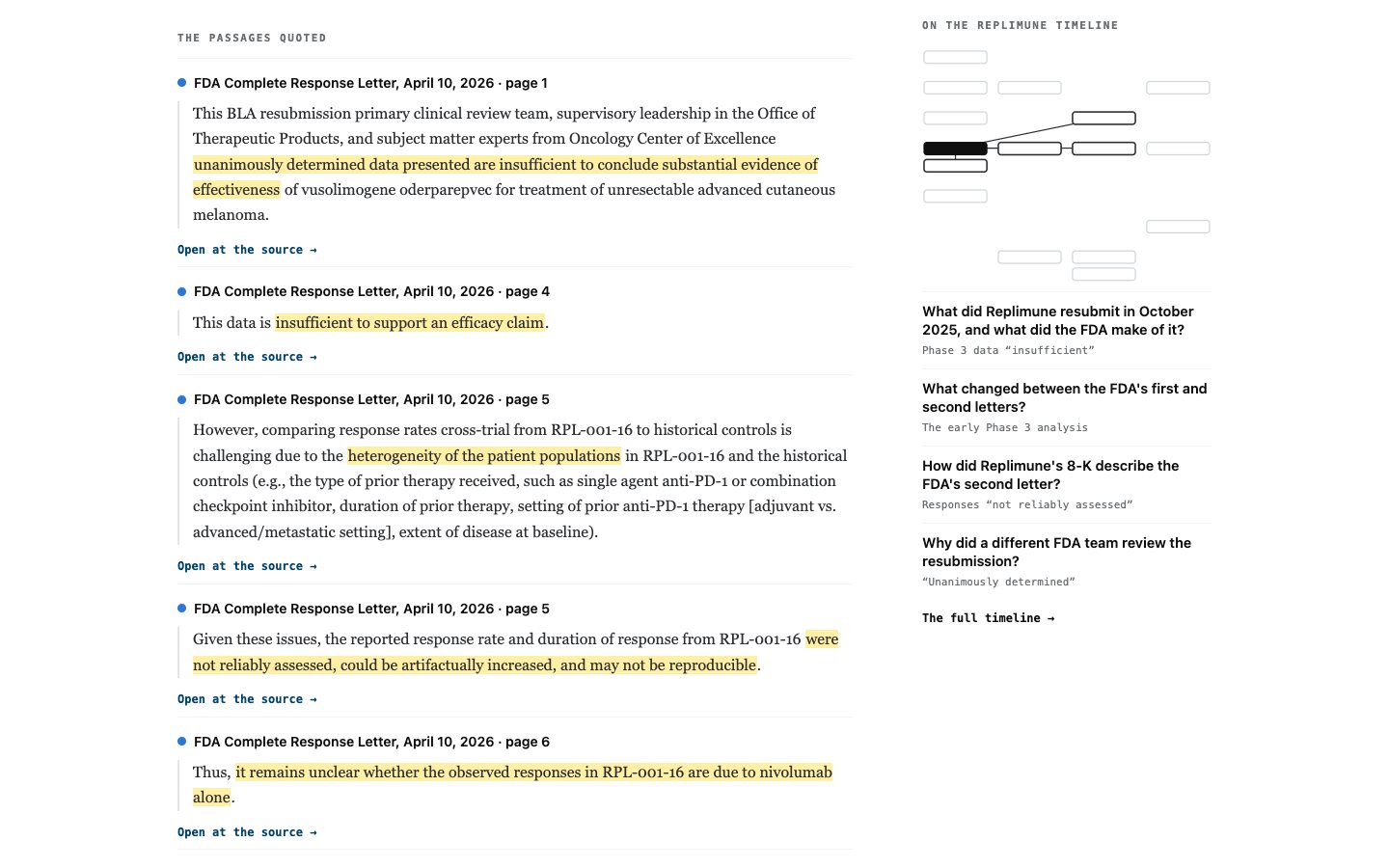
The last section lists every passage the answer quotes, in full:
- The heading names the document and, for a PDF, the page: FDA Complete Response Letter, April 10, 2026 · page 5.
- The passage is shown as the source prints it, with the words the answer quotes highlighted. Reading the whole sentence lets you check that the quote was not taken out of context.
- Open at the source → opens the original: an FDA letter at its PDF page (on download.open.fda.gov), or an SEC filing on sec.gov scrolled to the passage, where your browser supports it.
Longer articles#
Some questions are answered in a longer format, built for a reader new to the subject. The first is 51% vs. 28.1%: the FDA decision behind two RRP treatments. Instead of a short answer, it opens with a headline and an introduction, then adds:
- A chart of the figures being compared, each bar labelled with what it measures and cited to its source.
- A side-by-side table, In the FDA's and the companies' words, setting the two records against each other row by row.
- Numbered references: small superscript numbers after each claim, which link to the passage below.
- Sections that draw the consequences, such as Why the difference matters now and The open question.
The rules do not change. Every figure and every quote in the chart and the table is matched to its source, and the article ends with the same Follow the thread, The documents, by date and The passages quoted sections.
Why the page is laid out this way#
The order runs from least to most evidence: the short answer for a reader in a hurry, the narrative for one who wants the argument, and the passages for one who wants to check it. Every level can be checked against the next one down, and the last one against the original document. Nothing on the page asks to be taken on trust.
Related: How to read a deep research article · Question webs · How deep research is verified · Reading the record