Reasoning and evidence
Every concept-preview answer has a reasoning graph. Click a node to see the passage it rests on, checked against its source, or the search that found nothing.
Every answer on ephemerisx.com/ask sits on top of a reasoning graph: the findings the answer was built from, arranged in the order the argument runs. The graph is how you check the answer, one claim at a time.
The reasoning graph#
 1
2
3
4
5
6
7
8
9
1
2
3
4
5
6
7
8
9
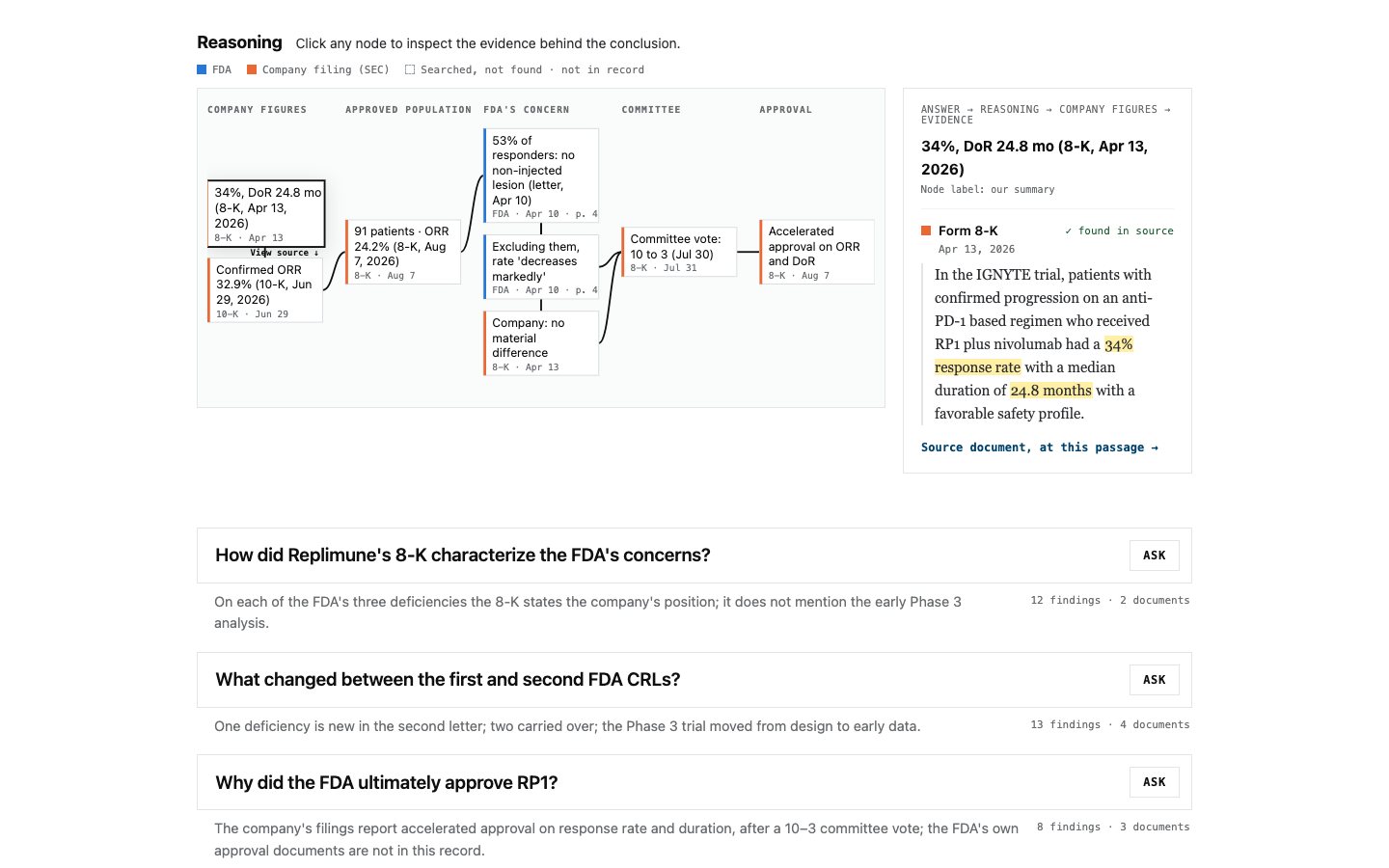
- 1Reasoning. Click any node to inspect the evidence behind the conclusion.
- 2Legend. A blue bar on a node's left side means an FDA document, orange a company filing (SEC). A dotted box was Searched, not found, or is not in record.
- 3Stages. Columns in the order the argument runs, left to right. Here: Company figures, Approved population, FDA's concern, Committee, Approval.
- 4A node. One finding: a short label in our words, and the document it comes from (8-K · Apr 13, FDA · Apr 10 · p. 4). The selected node has a dark border; View source ↓ appears under the node you point at.
- 5Path. Where this evidence sits: Answer → Reasoning → Company figures → Evidence.
- 6Node label. Repeated, and marked Node label: our summary, because it is ours, not the source's.
- 7The check. ✓ found in source: the passage was found, word for word, in the document.
- 8The passage. As the source prints it, with the words the answer relies on highlighted.
- 9Source link. Source document, at this passage → (or , page 4 → for an FDA letter) opens the original.
Explore the graph#
- Point at a node to light up its chain: everything it rests on, and everything that rests on it. Unrelated nodes fade.
- Click a node (or focus it and press Enter) to open its evidence in the panel on the right. The chain stays lit until you choose another node.
- Click a citation chip in the answer to open the same panel for that quote. The chip names the passage that holds the quoted words.
- When a graph first appears, the node the answer leans on most pulses gently: a good place to start.
Searched, not found#
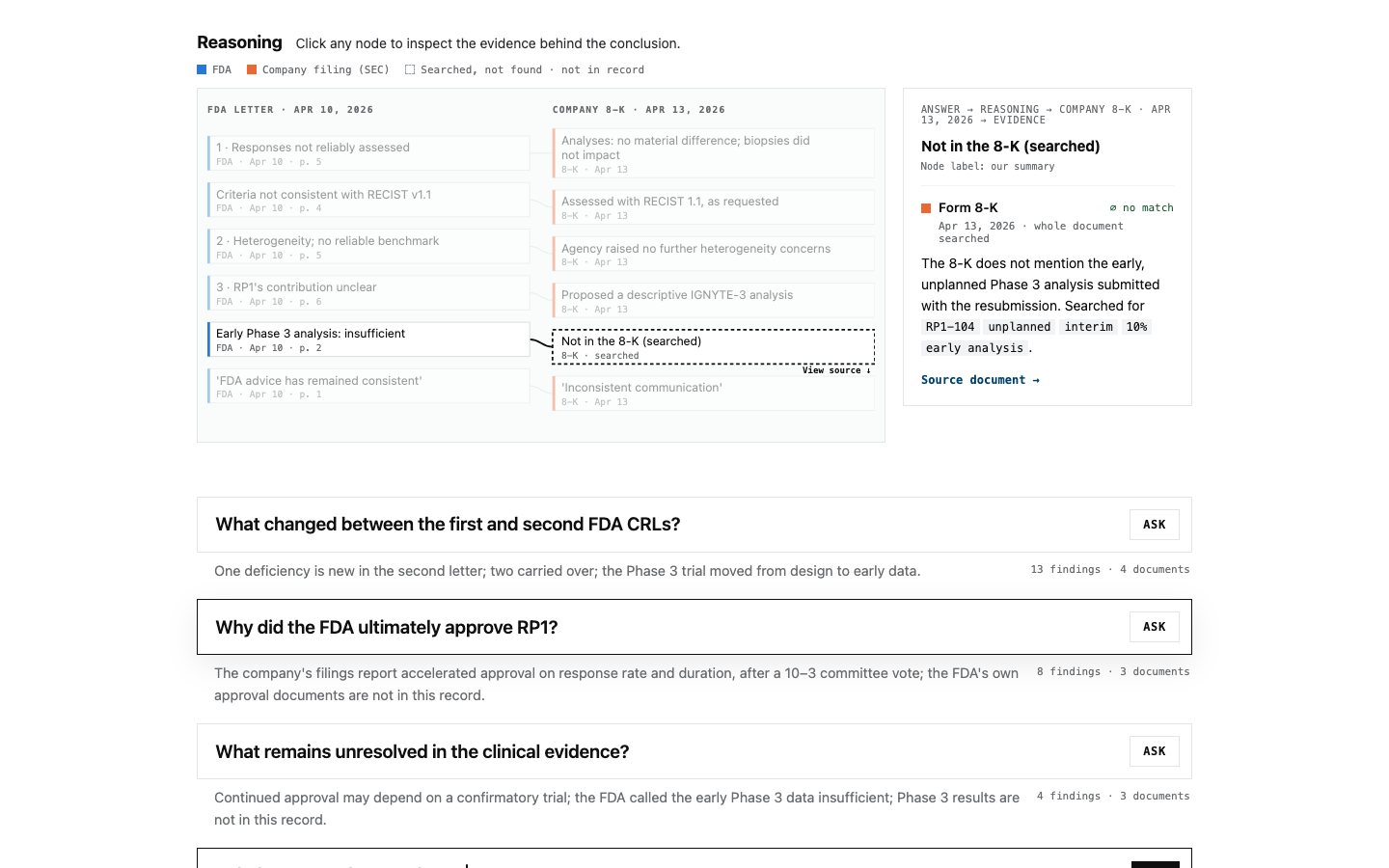
Some of the most useful findings are absences: what a company's filing does not say about the FDA's letter. These appear as dotted nodes.
 1
2
3
4
1
2
3
4
- 1Two columns, side by side. On this question, the FDA's letter on the left and the company's 8-K on the right, each FDA point opposite the company's account of it.
- 2The dotted node. Not in the 8-K (searched), opposite the FDA's point it does not address.
- 3∅ no match. Shown instead of ✓ found in source, with whole document searched.
- 4What was searched for. Every term, so you can repeat the search yourself in the document behind Source document →.
Where an answer names documents it did not search, the panel says so: This answer did not search these documents. They are named so the gap is visible. An answer can also say a document is not in this record; for example, the FDA's own approval documents for RP1 are not yet among the sources.
Why every answer comes with its graph#
A fluent answer is easy to produce and hard to check. The graph turns one paragraph into a set of findings, each small enough to check in seconds against the passage it rests on. If a finding fails, you can see exactly which part of the answer falls with it: that is what the chain is for.
Showing absences as nodes matters just as much. “The 8-K does not mention it” is a claim about the whole document; the dotted node makes it a claim you can test, with the search terms in front of you.
Related: Ask the Ephemeris · How deep research is verified · Trace an answer to its source