How to read a deep research article
A plain-language guide to our research: who is speaking on each page, what the FDA and SEC phrases mean, and one real article read line by line.
You do not need a background in drug regulation, oncology or finance to read our research. This guide shows you how. It covers who is speaking on the page, walks through one real article phrase by phrase, and lists the phrases that come up again and again. Every term links to a plain-language entry with the FDA's or the SEC's own definition:
- FDA approval terms: applications, letters, meetings, approvals, inspections.
- Cancer trial terms: trial designs, response rates, survival, tumour measurements.
- SEC filing terms: 8-Ks, 10-Ks, press releases, class actions.
Three voices on every page#
Every article mixes three voices. Telling them apart is most of the skill.
| Voice | How to spot it | How to read it |
|---|---|---|
| The FDA | In quotation marks, with a blue chip such as FDA · Apr 10, 2026 · p. 1 | The regulator's own words, from a letter it signed and published. |
| The company | In quotation marks, with a chip such as 8-K · Apr 13, 2026 or 10-K | What the company told investors. Accurate to what the company said, which is not always the same as what happened. |
| EphemerisX | Everything not in quotation marks: questions, summaries, connecting sentences | Our wording, written to connect the quotes. Check it against the quotes beside it. |
Watch for phrases that mark whose account you are reading: “as the company reports it”, “Aldeyra's filings say”, “the 2023 letter, as Aldeyra quotes it”. They mean the source is the company's description of a document, not the document itself.
One article, line by line#
Here is the start of What did the FDA's second letter object to? on Replimune's question web. Open it beside this page if you can.
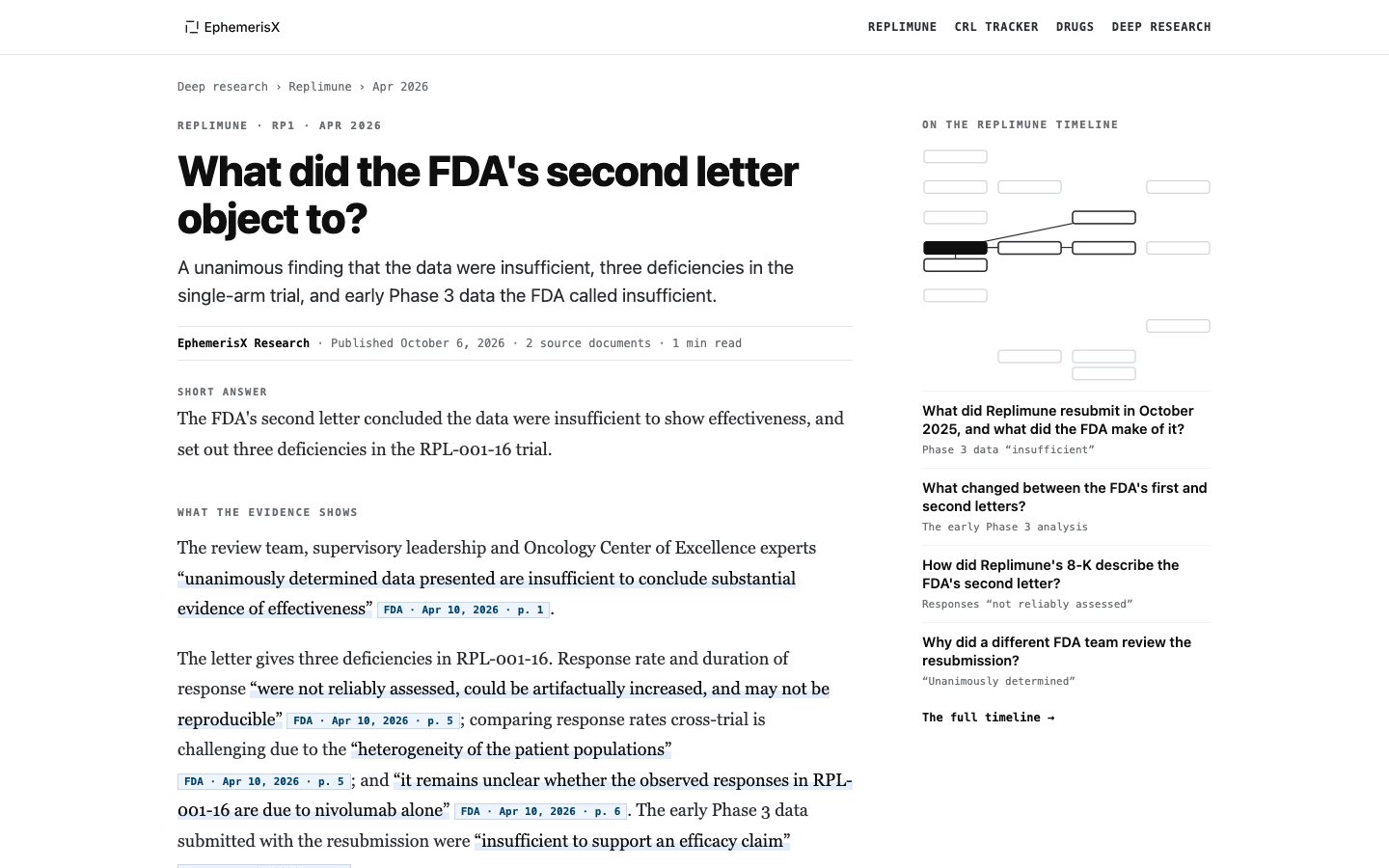
| The page says | In plain words | Look it up |
|---|---|---|
| “The FDA's second letter” | The second time the FDA refused to approve RP1 as submitted, and explained why. | Complete Response Letter |
| “insufficient to conclude substantial evidence of effectiveness” | The evidence did not clear the legal bar for showing the drug works. | Substantial evidence |
| “supervisory leadership and … Oncology Center of Excellence” | Not only the reviewers but their managers and the FDA's cancer specialists agreed. | OCE |
| “three deficiencies in RPL-001-16” | Three problems with RP1's main trial, a trial in which every patient got RP1. | Single-arm trial |
| “Response rate and duration of response … not reliably assessed” | The FDA did not trust the trial's count of how many patients' tumours shrank, or for how long. | ORR · DoR |
| “comparing response rates cross-trial … heterogeneity of the patient populations” | Comparing this trial with older trials is unreliable because the patients were too different. | Heterogeneity · Historical control |
| “due to nivolumab alone” | Patients got RP1 and nivolumab together; the responses might have come from nivolumab. | Combination therapy |
| “The early Phase 3 data submitted with the resubmission” | When Replimune sent its application back, it added an early look at its large trial; the FDA found it too early to count. | Phases · Resubmission |
| “adequate and well-controlled clinical trial(s)” | What the FDA said it needed: a properly controlled trial. | Adequate and well-controlled |
| “Its 8-K: Replimune disagrees … breakthrough therapy designation” | The company's announcement to investors, three days later, disputing the FDA's view. | 8-K · Breakthrough therapy |
Read that way, the article says something simple: the FDA did not trust the evidence from RP1's main trial, for three stated reasons, and wanted a properly controlled trial; the company publicly disagreed. Everything else on the page is the evidence for that sentence.
The shape of a regulatory history#
Most of our question webs follow the same arc. Knowing it tells you where any question sits:
Development. Trials in phases, meetings with the FDA, perhaps a Special Protocol Assessment or breakthrough therapy designation.
Application. An NDA or BLA, with a PDUFA goal date.
Decision. Approval, or a Complete Response Letter. The company files an 8-K within days.
Response. A Type A meeting, fixes, a Class 1 or Class 2 resubmission, or a formal dispute.
Outcome. Approval (perhaps accelerated, with a confirmatory trial to follow), or another letter, and the loop repeats.
Around it all. The company's 10-K and 10-Q reports, and sometimes a securities class action.
Phrases that tell you what kind of problem it is#
| If you see… | It usually signals |
|---|---|
| “substantial evidence of effectiveness”, “additional adequate and well-controlled study”, “single-arm”, “not reliably assessed” | An efficacy problem: the FDA is not convinced the drug works. Usually needs new clinical data. |
| “facility”, “inspection”, “Form 483”, “VAI”, “OAI”, “manufacturer”, “drug master file” | A manufacturing problem: the drug may work, but the FDA is not satisfied it can be made reliably. |
| “human factors”, “use”, “applicator”, “accidental exposure” | A usability problem with how the product is handled. |
| “labeling”, “proprietary name” | Often the end of a review: the FDA is discussing the label, or the drug's name. |
| “Not in the 8-K (searched)”, “does not mention” | Our finding that a filing leaves something out, backed by a search of the whole document. |
| “not in this record” | A document we have not got, or that is not public. A gap, not a negative. |
Questions to ask as you read#
- Whose words are these? FDA, company, or ours?
- What kind of problem is it? Efficacy, safety, manufacturing, usability?
- Has it come up before? Check Follow the thread for the same concern in an earlier letter.
- Does the company's account match the letter? Compare the blue and orange quotes.
- What is still unknown? Look for “not in this record” and the question What remains unresolved?
Related: Question pages · Reading the record · Glossary